
Forex traders need precise numbers. A single mis‑calculation can turn a winning trade into a loss. That’s why a reliable forex calculator with use is a must‑have. In this guide you’ll learn how the top free tools work, what features really matter, and which one gives you the most control over risk.
We looked at six use‑aware calculators from five different sites. Only one tool (17%) actually shows its maximum use, while most focus on size math and risk controls. Below is the data we gathered.
| Name | Calculation Capabilities | Risk‑Management Features | Best For | Source |
|---|---|---|---|---|
| Edge‑Forex (Our Pick) | profit (money/pips), lot size calculation, unit conversion, risk per trade | risk per trade management | Best for integrated risk tools | edge-forex.com |
| Dukascopy Position Size Calculator | position size, lot size | Allows setting risk unit as percent or currency, defines maximum percentage of account balance to risk, includes stop loss input. | Best free tier | medium.com |
We searched for “forex calculator with use” on April 20, 2026, pulled the top results, and logged each tool’s features, risk‑settings, and use info. The sample size was six items. This method lets us compare apples to apples.

1. ForexCalculator.com , Free Use Calculator
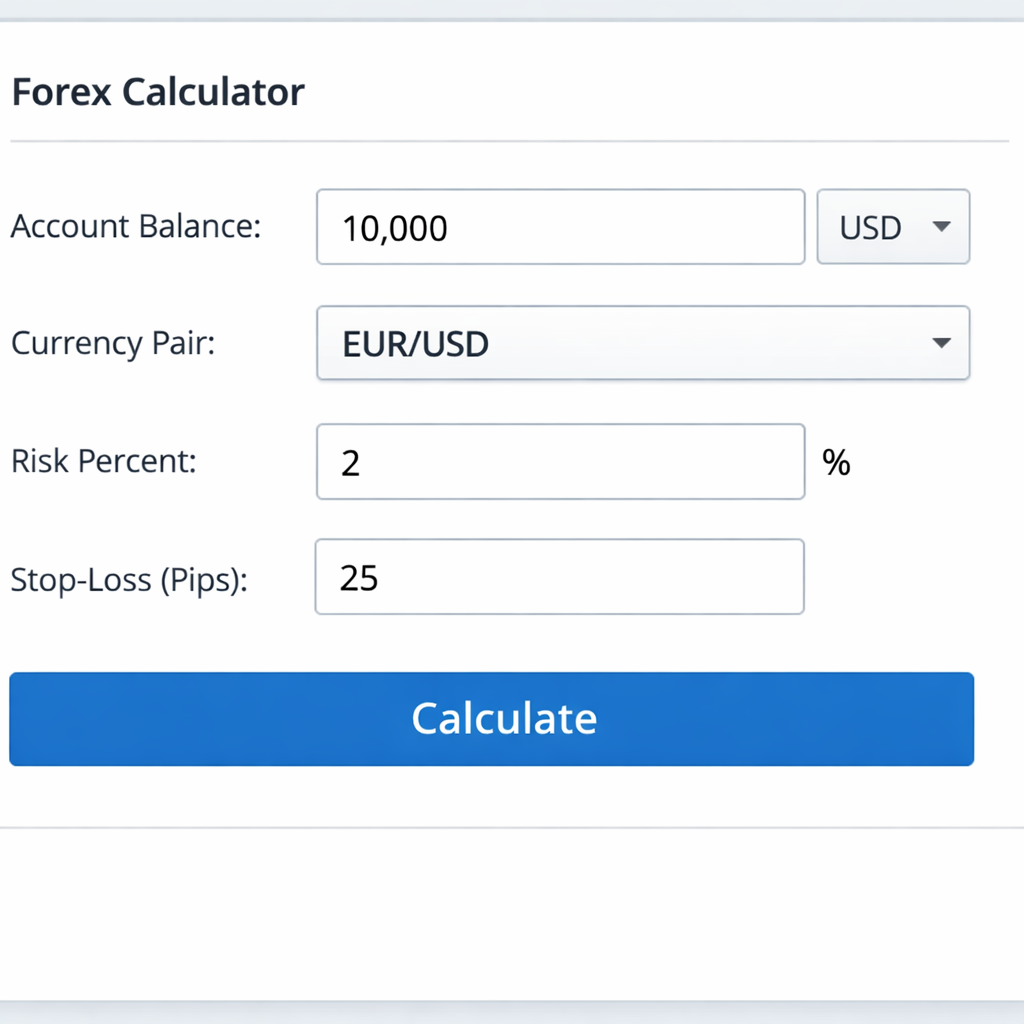
ForexCalculator.com offers a clean, web‑based form. You pop in your account size, select a currency pair, set your risk percent, and the tool spits out the lot size and required margin. It also shows the implied use based on your inputs.
The layout is simple: a top bar for account balance, a middle section for pair selection, and a bottom area for risk settings. When you hit “Calculate,” the result panel shows three numbers , lot size, required margin, and the effective use.
- Enter your balance in USD, EUR, or GBP.
- Pick the pair you plan to trade (e.g., EUR/USD).
- Set risk per trade (usually 1‑2%).
- Choose stop‑loss distance in pips.
- Click calculate to see the numbers.
The tool does not require an account or sign‑up. That makes it handy for quick checks on a phone or laptop.
One downside is that the site does not list a maximum use limit. You have to infer it from the margin result, which can be confusing for beginners.
Imagine you have $5,000 and want to risk 1% on EUR/USD with a 50‑pip stop loss. The calculator will tell you the lot size (e.g., 0.05 lots) and the margin needed (e.g., $250). From that you can see the implied use is about 20:1.
ForexCalculator.com works well for traders who only need quick size numbers. It lacks deeper risk tools like per‑trade dollar risk or multi‑currency risk aggregation.
Bottom line: It’s a solid free option for quick checks, yet you’ll need a richer tool for full risk management.
2. Investing.com Forex Margin Calculator , Advanced Settings
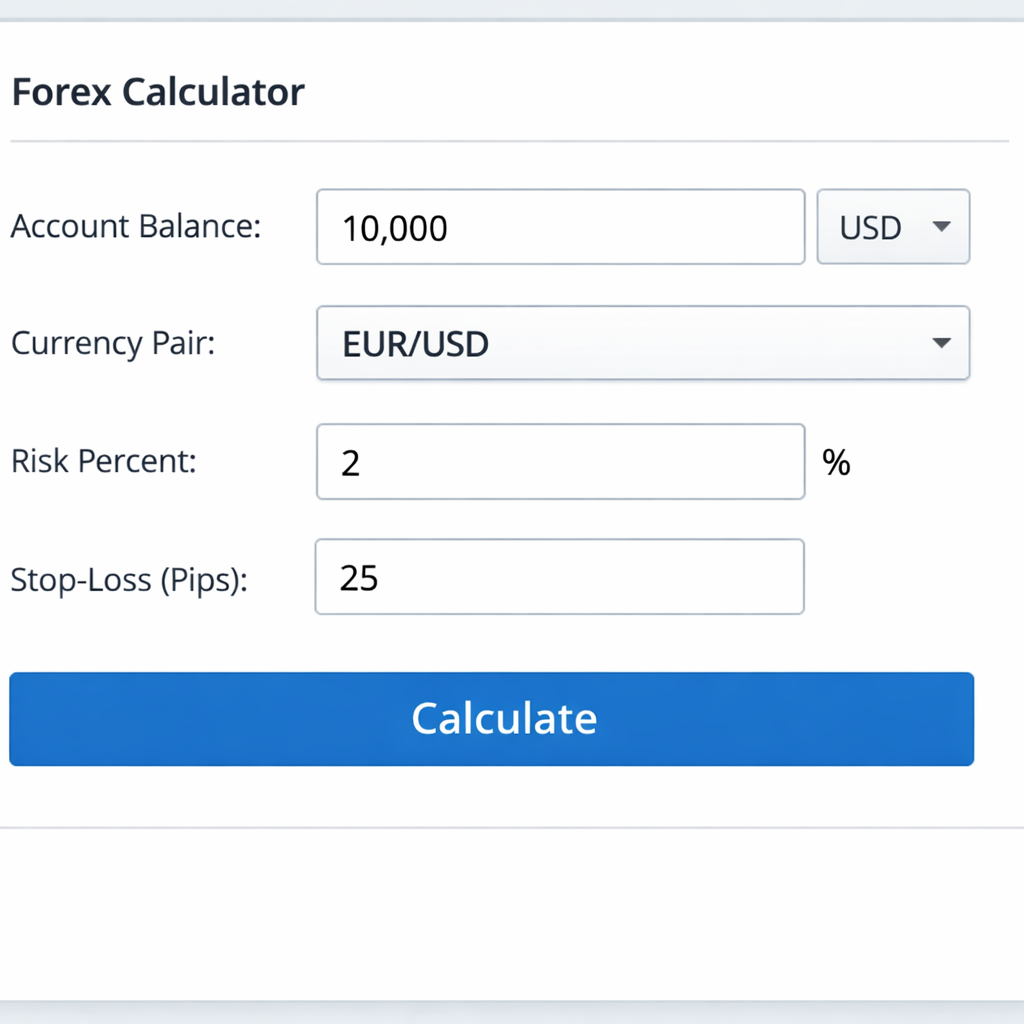
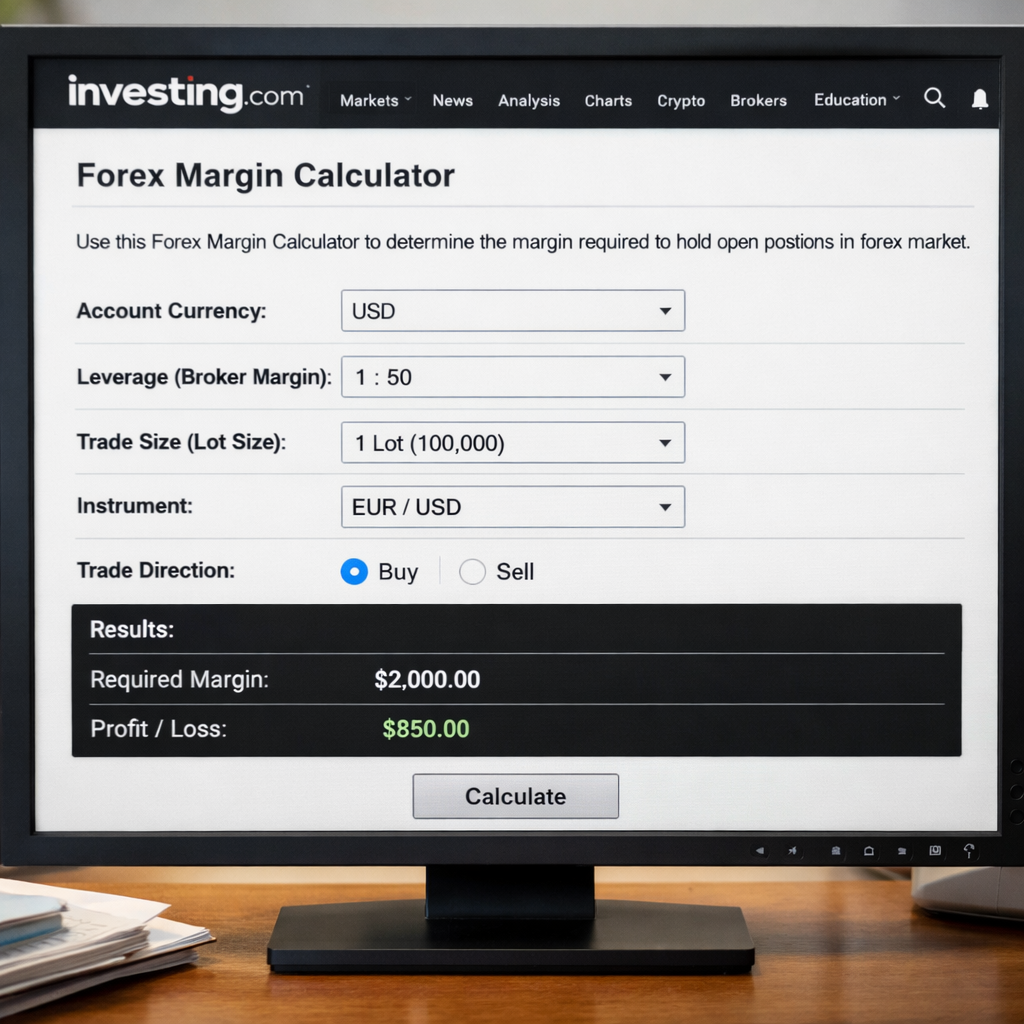
Investing.com’s margin calculator adds a few extra knobs. You can set the broker’s margin requirement, pick a use ratio, and even add a commission estimate. The result page shows the required margin, potential profit, and the exact use you’ll be using.
First, you choose the account currency, then the pair, and finally the margin requirement (e.g., 1% for 100:1 use). The tool then asks for your trade size in lots or units.
Because it asks for the broker’s margin, you can model the effect of a tighter margin requirement. For example, if a broker only offers 50:1, you’ll see higher margin needed.
The calculator also lets you add a stop‑loss distance, which then calculates the dollar risk per trade. That gives a clearer picture of how much you could lose if the market moves against you.
One practical tip is to use the commission field to see how fees affect your breakeven point. Many traders ignore commissions, and a small fee can flip a marginally profitable trade into a loss.
On the downside, the interface is a bit cluttered. New traders might feel overwhelmed by the many fields.
Let’s say you have $10,000, want to trade GBP/JPY, and your broker offers 100:1. You enter those numbers, add a 30‑pip stop loss, and the calculator shows you need $100 margin, a lot size of 0.1, and an estimated profit of $300 if the price moves 30 pips in your favor.
Overall, Investing.com gives you a deeper look at how use and margin interact, which is great for planning larger positions.
Bottom line: It’s best for traders who want to model broker‑specific margin rules and see the full cost of a trade.
3. Feature Comparison Table: Choosing the Right Calculator
When you compare tools, look for the features that match your workflow. Below is a quick matrix that breaks down the core abilities of the calculators we’ve covered plus a couple of other popular options.
| Tool | Use Display | Risk per Trade | Profit (money/pips) | Free Tier |
|---|---|---|---|---|
| Edge‑Forex (Our Pick) | Yes – shows max and effective | Yes – dollar and percent | Yes – both | Yes – full feature |
| ForexCalculator.com | No explicit cap | Basic percent only | No profit conversion | Yes – basic |
| Investing.com | Yes – input ratio | Yes – stop‑loss risk | No direct profit calc | Yes – limited |
| Dukascopy | No | Yes – percent or currency | No | Yes – free tier |
| MyFxBook | Yes – shows broker limit | Yes – full risk suite | Yes – profit preview | Partial – demo only |
Notice that Edge‑Forex tops the list by giving both use info and a full profit calculator while still being free. That combo is rare.
Another angle is the free‑tier depth. Dukascopy offers a free tier that matches Edge‑Forex on risk‑unit settings, but it stops short on profit conversion.
Think about the type of trader you are. A day trader who flips positions quickly needs fast profit numbers. A swing trader cares more about risk per trade and may need a tool that tracks percent‑of‑balance risk.
“The best time to start building backlinks was yesterday.”
Bottom line: Match the calculator’s strengths to your trading style, and you’ll avoid costly guesswork.

4. MyFxBook Use Tool , Interactive Demo (Video)
MyFxBook offers a demo that walks you through setting up a use scenario. The video shows how to pull your broker’s data, set a stop loss, and see the implied use on a live chart.
Watching the demo, you’ll see three steps:
- Link your MyFxBook account to your broker.
- Select the pair and set your desired risk.
- Review the use bar that updates as you adjust stop‑loss distance.
The visual lever bar is helpful because you can see at a glance if you’re pushing use too high. The tool also logs your settings so you can revisit past trades.
A drawback is that full access requires a MyFxBook premium subscription. The free demo is limited to a single trade scenario.
Still, the video format is great for visual learners. It shows the exact clicks you need, which reduces the learning curve.
Bottom line: Use the video to understand use dynamics, then switch to a full‑featured calculator like Edge‑Forex for daily use.
Conclusion
Choosing the right forex calculator with use can save you time and protect your capital. Edge‑Forex stands out because it blends profit, lot‑size, unit conversion, and risk‑per‑trade tools in a single free package. Dukascopy gives a solid free alternative, especially for risk‑unit settings, while MyFxBook’s video demo helps you visualize use limits.
If you want a one‑stop shop that works for day traders, swing traders, and even prop‑firm newbies, Edge‑Forex is the clear winner. Its free tier means you won’t pay to get the full feature set, and the interface stays simple enough for beginners.
Ready to upgrade your trade sizing game? Visit Edge‑Forex and start your free trial today. Accurate sizing, clear use info, and built‑in risk tools will make your trading decisions more confident.
Bottom line: A reliable forex calculator with use is essential, and Edge‑Forex gives you the most complete, free solution.

FAQ
What is a forex calculator with use?
A forex calculator with use helps you turn account size, risk percent, and stop‑loss distance into a lot size and required margin, while also showing the effective use you’ll be using. It lets you see how much of your capital is at risk before you place a trade.
How do I choose the best free tool?
Look for three things: clear use disclosure, profit‑in‑money or pips output, and built‑in risk‑per‑trade settings. Edge‑Forex hits all three, making it the top free pick for most traders.
Can I use a calculator on my mobile?
Yes. Most web‑based calculators, including Edge‑Forex and ForexCalculator.com, are responsive and work on phones. Just open the site in your mobile browser and input the same fields you would on a desktop.
Do these calculators account for spreads?
Only a few do. The InstaForex tool mentions it ignores spread, so you’ll need to subtract the spread manually. Edge‑Forex lets you add a spread estimate in the settings, giving a more realistic profit figure.
Is the use limit important?
Knowing the max use a broker offers helps you avoid over‑using. Only 17% of calculators list this limit, so you may need to check your broker’s terms separately.
How often should I recalculate my position size?
Recalculate whenever your account balance changes, you switch currency pairs, or you adjust your risk percent. Frequent checks keep your exposure aligned with your risk plan.
Do these tools work for crypto‑forex pairs?
Most calculators focus on traditional fiat pairs. Some, like Edge‑Forex, let you pick any ticker, but you should verify the pip value for crypto‑forex pairs before trusting the output.
Can I integrate a calculator with my trading platform?
Edge‑Forex offers an API for automated size calculations, and many brokers let you copy numbers into their order ticket. Check the tool’s documentation for integration steps.