
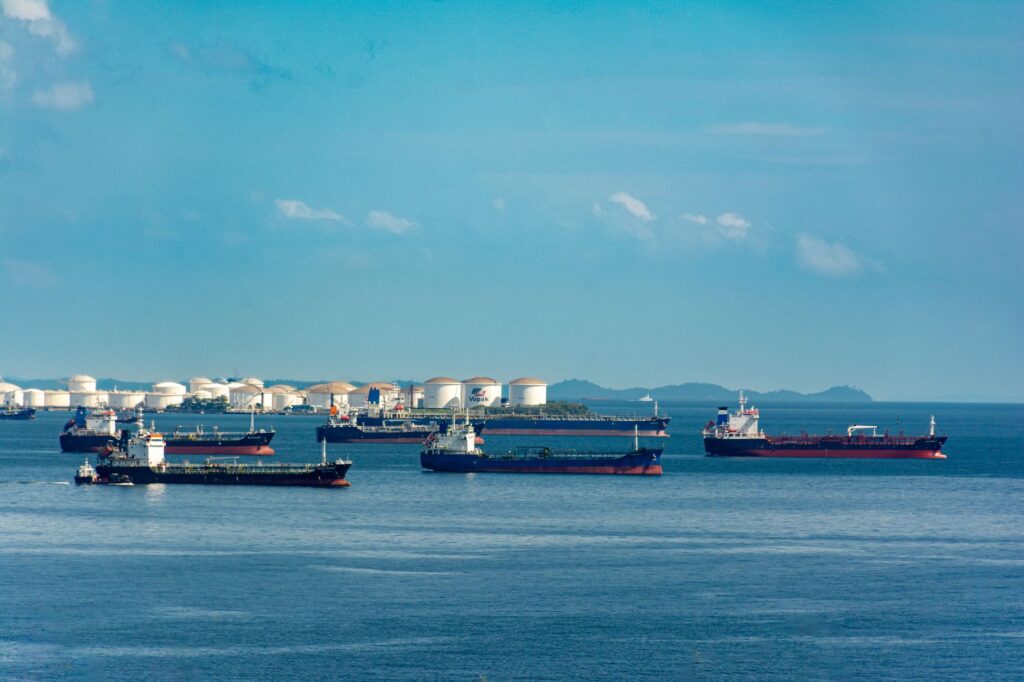
Brent crude pushed above $91 a barrel after an unidentified projectile struck a vessel transiting the Strait of Hormuz, injuring crew and damaging the engine room. That single incident is a symptom, not the cause, of a much larger repricing of Middle East risk that has been building for weeks. For forex traders, the real story isn’t the headline number on oil futures — it’s how Hormuz oil shock currencies are quietly realigning as energy costs, safe-haven flows, and central bank reaction functions collide.
This post uses the tanker incident as a jumping-off point. The bulk of what follows is analysis: which pairs move, why, who wins, and where the trade could go wrong.

Why Hormuz Risk Is a Currency Story, Not Just an Oil Story, Hormuz oil shock currencies
Roughly a fifth of global seaborne oil and a huge share of LNG passes through Hormuz. When tanker traffic slows to a trickle, as it has done repeatedly this year, the transmission mechanism into FX is straightforward: energy-importing economies face terms-of-trade shocks, while energy-exporting economies see windfall gains. However, the speed and asymmetry of that transmission is what actually creates tradeable dislocations.

Currency markets price this through three channels. First, current account dynamics — countries that import most of their crude see their trade balance deteriorate immediately. Second, inflation expectations — higher energy costs feed into headline CPI, forcing central banks to reassess policy paths. Third, risk sentiment — escalation in the Gulf tends to trigger broad risk-off flows into traditional havens, even when those havens are themselves oil importers, which creates the classic tension traders love to exploit.
The Pairs Most Exposed
JPY: The Double-Edged Haven
The yen is the most conflicted currency in this setup. Japan imports nearly all its crude, so a sustained Brent rally above $90 directly worsens its import bill and trade deficit — a fundamentally bearish JPY driver. Yet the yen also carries decades of muscle memory as a safe haven, meaning geopolitical shocks can trigger reflexive JPY buying even as the underlying fundamentals argue the opposite way. This tug-of-war has been explored in detail elsewhere, and it’s worth reading how the JPY oil import bill keeps weighing on the currency even as acute supply fears occasionally ease. Traders should watch USD/JPY for choppy, two-sided price action rather than a clean directional move.
CAD and NOK: The Beneficiaries
Oil-exporting currencies stand to gain the most directly. The Canadian dollar and Norwegian krone both benefit from higher crude prices through improved terms of trade and stronger export revenue. CAD tends to show the cleanest correlation with WTI, while NOK’s relationship with Brent is reinforced by Norway’s sovereign wealth mechanics. As a result, long CAD or NOK against oil-importing currencies like JPY or KRW is a structurally sound way to express a “Hormuz risk stays elevated” view, though execution timing matters given volatility spikes around headlines.
USD: The Complicated Middle Ground
The dollar’s reaction is less obvious. The U.S. is now a large net oil producer, so higher crude prices are less damaging to the American economy than in past decades. Meanwhile, broad risk-off episodes still tend to support the dollar through pure safe-haven demand, even against currencies with better direct oil exposure. This means USD often ends up strengthening against risk-sensitive currencies (AUD, NZD, emerging-market FX) while underperforming against CAD and NOK in the same session — a nuance that gets lost in simplistic “oil up, dollar down” narratives.
Who Benefits From This Move
Macro funds holding long CAD/JPY or long NOK/JPY positions are the clearest beneficiaries of sustained Hormuz escalation, since they capture both the oil-exporter tailwind and the oil-importer headwind simultaneously. Commodity trading advisors running trend-following models on Brent also gain indirectly through correlated FX positioning. On the flip side, carry traders who had been short JPY purely for yield differentials face growing headline risk, since any escalation can trigger sharp, unhedged JPY spikes that blow through stop levels.
Asian refiners and importers — Japan, South Korea, India — are structurally disadvantaged the longer this drags on. That said, some of that pain is being cushioned by diversified sourcing and strategic reserve builds, which slows but doesn’t eliminate the FX drag. For a deeper look at how the broader supply chain stress filters into currency markets beyond the obvious pairs, see this breakdown of Hormuz supply chain FX dynamics.

Positioning and Risk Management
Given the headline-driven nature of this trade, position sizing discipline matters more than usual. A single UKMTO notice can move Brent by a dollar or two within minutes, and correlated FX pairs follow suit. Traders should size positions assuming gap risk over weekends and during Asian session hours when liquidity thins and headlines tend to break.

Key Caveats
This analysis assumes escalation persists or worsens. That assumption could fail quickly. A diplomatic breakthrough, even a partial one, would unwind much of the CAD/NOK strength and JPY volatility premium almost overnight. Additionally, if U.S. shale supply responds aggressively to higher prices, the oil-exporter tailwind for CAD could fade faster than expected. Finally, central bank reaction functions are not guaranteed — if the Fed or Bank of Japan judge the shock as transitory, currency responses could decouple from oil price action entirely.
Traders should treat Hormuz oil shock currencies as a live, evolving theme rather than a settled directional bet. Monitor tanker traffic data, UKMTO notices, and Brent’s technical structure alongside standard FX calendars, since this is one of the rare setups where shipping logs matter as much as central bank minutes.
Source: OilPrice
</markdown>

I’m Vinit Makol. With 20+ years in forex and financial markets, I serve as lead analyst at Edge-Forex, covering currency markets, macroeconomics, trading strategies, and market-moving events to give traders practical insights they can actually use.