Forex Market Hours in London Time: Every Session in GMT and BST
Forex market hours in London time: when each session opens and closes in GMT and BST, the 13:00–17:00 overlap, and the weeks UK and US clocks drift apart.
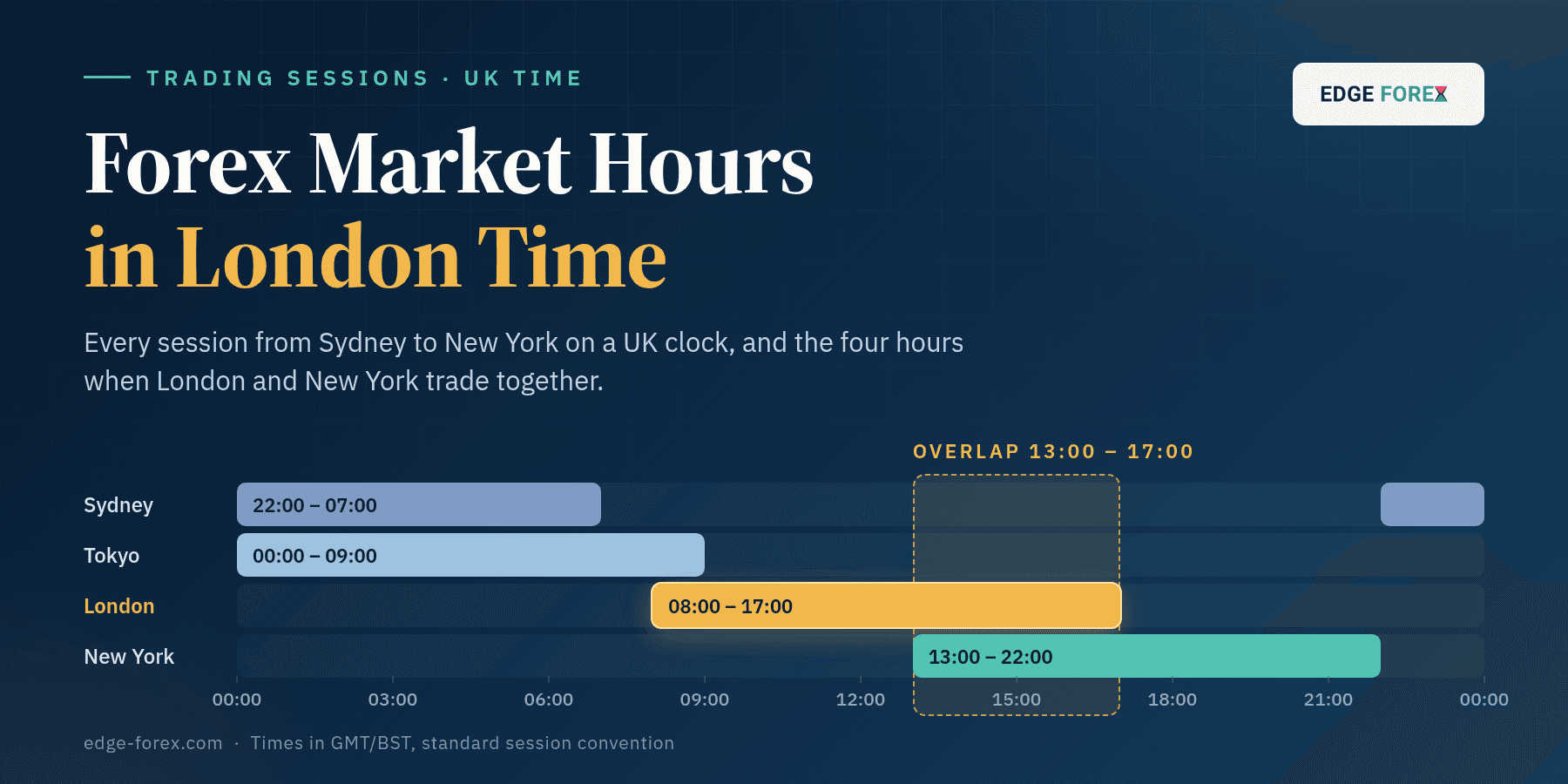
The forex market runs from 22:00 on Sunday to 22:00 on Friday, UK time. London's own session is 08:00 to 17:00, and the busiest stretch of the day is 13:00 to 17:00, when New York is open as well.
Those clock times hold all year on a UK wall clock, with one catch. For two to three weeks each spring and one week each autumn, the UK and the US change their clocks on different dates, and New York's open slides an hour earlier. The schedule below covers both cases.
- Week opens: Sunday 22:00 UK time (Sydney)
- Week closes: Friday 22:00 UK time (New York)
- London session: 08:00 to 17:00
- Best liquidity: 13:00 to 17:00, London and New York open together
- Watch for: the weeks when UK and US clocks are out of step
Forex session times on a UK clock
Four regional sessions make up the trading day, each tied to the working hours of its financial centre. The times below follow the standard convention, which pins every session to New York's clock. Because the UK and the US move their clocks together for most of the year, the UK column stays the same in winter and summer.
| Session | UK time | New York | UTC winter / summer |
|---|---|---|---|
| Sydney | 22:00–07:00 | 17:00–02:00 | 22:00–07:00 21:00–06:00 |
| Tokyo | 00:00–09:00 | 19:00–04:00 | 00:00–09:00 23:00–08:00 |
| London | 08:00–17:00 | 03:00–12:00 | 08:00–17:00 07:00–16:00 |
| New York | 13:00–22:00 | 08:00–17:00 | 13:00–22:00 12:00–21:00 |
Sources differ by up to an hour on where Sydney and Tokyo start and end, because both trade on their own local clocks. London and New York are the two to rely on.
Sydney and Tokyo drive the Australian dollar, the New Zealand dollar and the yen. London is the centre of the market: the UK handled roughly 38% of global foreign exchange turnover in the Bank for International Settlements' 2022 survey, with the US second at about 19%. New York matters because the dollar sits on one side of most trades.
A trading day in UK time
Sessions are only half the story. Scheduled news lands at fixed times, and those times shape the day as much as the opens and closes do.
| UK time | What happens |
|---|---|
| 22:00 Sun | The week opens. Sydney desks trade thin books, and Monday gaps are filled or extended here. |
| 00:00 | Tokyo opens. Yen pairs and the Australian and New Zealand dollars are at their most active. |
| 07:00 | UK data releases (CPI, GDP, the jobs figures) and European desks come online. Sterling can move before London formally opens. |
| 08:00 | London opens. Euro and sterling pairs pick up, and Tokyo is still trading until 09:00. |
| 12:00 | Bank of England rate decisions, on eight Thursdays a year. |
| 13:00 | New York opens and the London and New York overlap begins. |
| 13:30 | US data hits: the jobs report, CPI and retail sales (08:30 in New York). |
| 16:00 | The London fix. Benchmark rates are set, and month-end rebalancing can move prices. |
| 17:00 | London closes. Liquidity in sterling and euro pairs thins and spreads widen. |
| 22:00 | New York closes and the daily rollover runs. Spreads widen briefly. On Friday this is the end of the week. |
The London and New York overlap
From 13:00 to 17:00 the two biggest financial centres trade at once. Liquidity is deepest, spreads are usually at their tightest on the majors, and the most important US releases arrive at 13:30, so the overlap also carries the sharpest moves of the day.
GBP/USD, EUR/USD, USD/CAD and gold all tend to trade best in this window. If you want the reasoning behind it, our guide on the best time to trade forex explains how volatility and spreads change through the day, and forex market hours and best times to trade covers the global picture.
When UK and US clocks drift apart
The US changes its clocks on the second Sunday of March and the first Sunday of November. The UK changes on the last Sunday of March and the last Sunday of October. In between, the two are out of step, and New York's open lands an hour earlier on a UK clock.
| Period | New York opens | Overlap | Week opens |
|---|---|---|---|
| Most of the year UK and US clocks match | 13:00 | 13:00–17:00 4 hours | Sun 22:00 |
| Spring gap US clocks go forward on the second Sunday of March, the UK on the last. Two to three weeks. | 12:00 | 12:00–17:00 5 hours | Sun 21:00 |
| Autumn gap UK clocks go back on the last Sunday of October, the US a week later. One week. | 12:00 | 12:00–17:00 5 hours | Sun 21:00 |
In those weeks the US data that normally arrives at 13:30 lands at 12:30, which catches out anyone who set an alert and forgot. Check the dates at the start of March and the end of October, and the problem goes away.
Which session suits which market
| Market | Best window (UK time) | Why |
|---|---|---|
| EUR/USD | 08:00–17:00, strongest 13:00–17:00 | The most traded pair, with both regions active. See the best time to trade EUR/USD. |
| GBP/USD | 07:00–17:00 | UK data at 07:00 and the London session carry most sterling volume. |
| USD/JPY | 00:00–09:00 and 13:00–17:00 | Tokyo flows first, US data afterwards. See the best time to trade USD/JPY. |
| AUD/USD, NZD/USD | 22:00–07:00 | Sydney and Tokyo hours, when Australian and New Zealand data is released. |
| USD/CAD | 13:00–17:00 | US and Canadian data both come out at 13:30. |
| Gold (XAU/USD) | 13:00–17:00 | It reacts to US data and the dollar. See the best time to trade gold. |
Sizing a trade at the London open
Here is how the numbers work on a typical setup. The figures are illustrative, not a live price or a recommendation.
A trader has a $10,000 account and risks 1% a trade, so $100. They plan to buy GBP/USD after the 08:00 London open, with a stop 20 pips below entry.
$100 divided by 20 pips is $5 a pip, which is 0.5 of a standard lot (50,000 units). With a 30 pip stop, the same $100 risk gives about $3.33 a pip, or roughly 0.33 lots.
The stop sets the size, not the account balance. London opens can move 20 pips in minutes, so choose the stop from recent volatility first and let the position size follow. Our forex trading calculator does this arithmetic for any pair.
Three mistakes UK traders make with session times
- Treating 13:00 as fixed. In the clock-gap weeks the overlap starts at 12:00 and US data arrives at 12:30. Check before the week begins.
- Holding into the weekend close with no plan. Liquidity is thin after 17:00 on Friday, and prices can gap at the Sunday 22:00 open.
- Ignoring holidays. The market stays open on UK bank holidays and on US holidays such as Thanksgiving, but volume drops and spreads widen. Christmas week is the extreme case.
Frequently asked questions
What time does the forex market open in London time?
The trading week opens at 22:00 UK time on Sunday, when Sydney comes online. London itself opens at 08:00 and closes at 17:00, Monday to Friday.
What is the best time to trade forex in the UK?
13:00 to 17:00 UK time. London and New York are both open, liquidity is deepest and spreads are usually tightest on the major pairs.
Is the forex market open 24 hours a day?
Yes, from Sunday 22:00 to Friday 22:00 UK time. There is always at least one major centre open during that window, and the market is closed over the weekend.
Do forex market hours change with UK daylight saving time?
On a UK wall clock they barely change, because London and New York both shift together. They only move in the roughly three weeks each spring and one week each autumn when the UK and US change clocks on different dates. In UTC terms the London session moves from 08:00 to 17:00 in winter to 07:00 to 16:00 in summer.
When does the London forex session close?
At 17:00 UK time. Liquidity in sterling and euro pairs thins out after that, and New York keeps trading until 22:00.
Trading from another time zone? We have the same schedule for Dubai time and India (IST). For sentiment before you trade a session, see our guide to the Gold Mood fear and greed index.
We post daily setups and market breakdowns on Telegram: join Pip Talk.
Educational content, not financial advice. Leveraged trading carries a high risk of loss. Session times reviewed 18 November 2026.
Edge-Forex publishes general market analysis, not investment advice. Market data shown is indicative and may be delayed.
Written by
Vinit Makol
Lead Strategist and Market Analyst at Edge-Forex
Vinit Makol is a forex trader, strategist and market analyst with more than 20 years of experience in forex and financial markets.
Covers